What a website in Romania legally needs
A business website in Romania needs a few things required by law:
- the business details;
- a privacy policy (on practically any website);
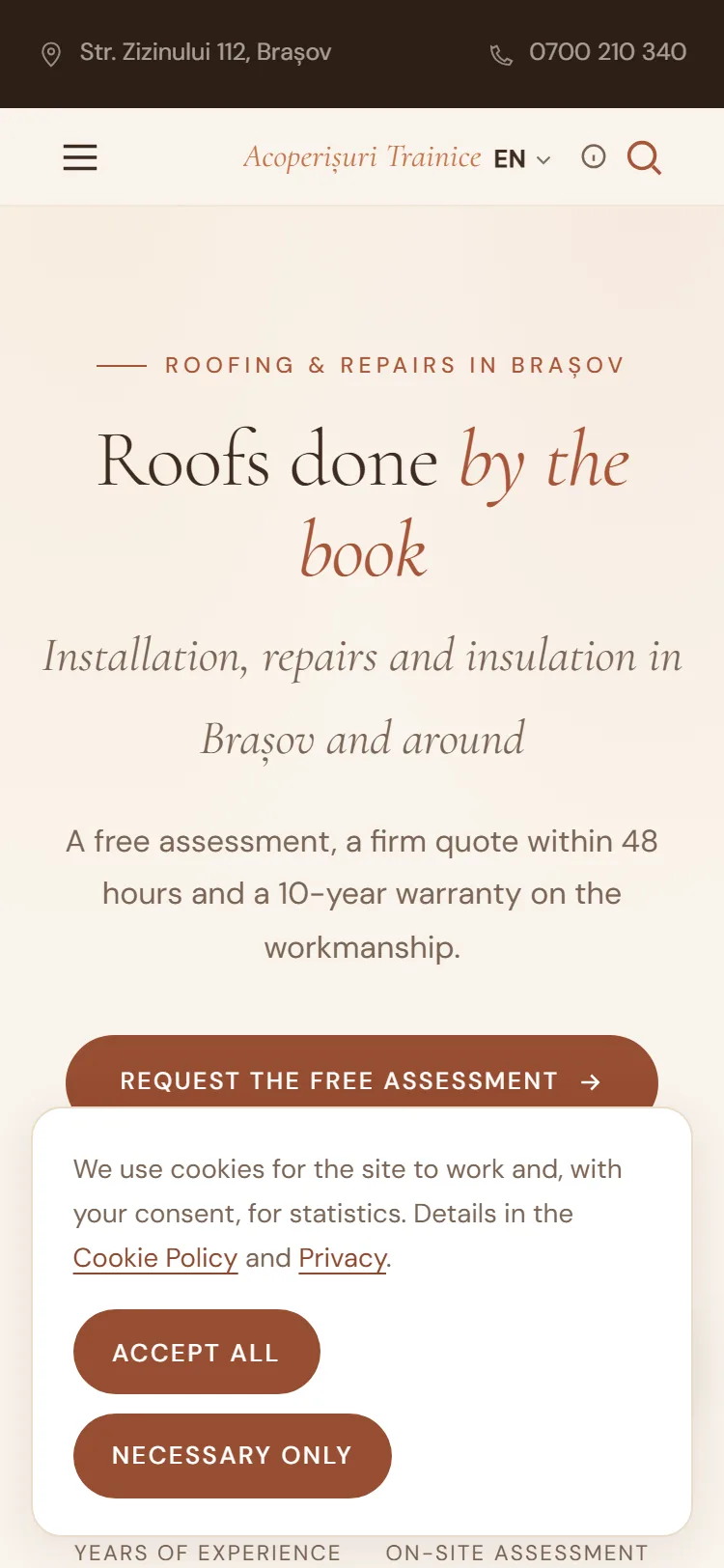
- a cookie policy, with the consent banner, if you use cookies that aren't strictly necessary;
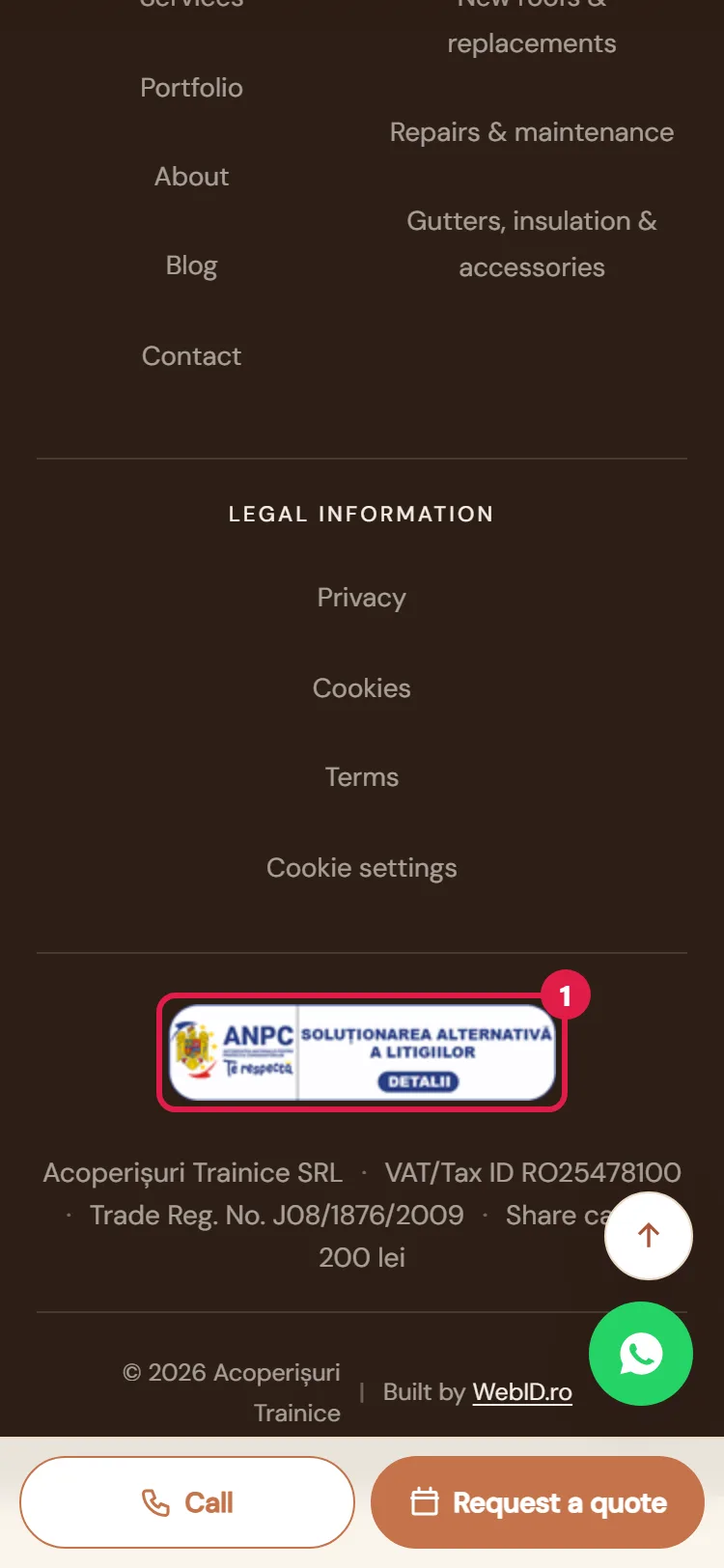
- the ANPC (the Romanian consumer protection authority) icon for complaints (SAL, alternative dispute resolution), if you work with private individuals.
The law doesn't require a terms and conditions page as such: you only need its content if you take appointments, orders or payments through the website. Below you'll find all of them, explained in plain language: what each one is, when you need it and what it must include.
This article helps you know what to ask for and what to check. It doesn't replace a lawyer: for your exact situation, ask one. For everything a business website needs, not just the legal side, see the checklist.
1. The business identification details
What it is: the information that shows who owns the website.
When you need it: on any website of a business that offers services or products (Legea 365/2002, art. 5; the Romanian e-commerce law).
What it includes: the company name, the registered office, the phone number, the email address, the Trade Register ("Registrul Comerțului") number and the CUI (tax identification number). For an SRL (limited liability company), the share capital too. If your profession is regulated (doctor, lawyer, psychologist), your professional title and the professional body you belong to are added. These professions also have advertising rules, set by each one's professional body.
Where they usually go: in the footer of every page and on the contact page.
2. The privacy policy
What it is: the page that tells visitors what data you collect about them, why, how long you keep it and what rights they have over it.
When you need it: on practically any website, because even the server that hosts it logs visitors' IP addresses. And when you collect data through the website (a contact or appointment form, a newsletter, visitor statistics), the policy must cover all of it (GDPR, art. 13).
What it includes: who collects the data (your business), what data, for what purpose, on what legal basis, who you pass it on to (for example, the hosting company), how long you keep it, what rights the person has (access, erasure, objection) and how they can contact you.
Watch out: the text must describe what your website does, not someone else's. One copied from another website usually promises things your website doesn't do, or leaves out the ones it does.
3. The cookie policy and the consent banner
What it is: the page that explains which cookies (and other information stored in the browser) the website uses, plus the banner where people choose what they accept.
When you need it: when the website uses cookies that aren't strictly necessary: visitor statistics, maps or videos embedded from others, ads (Legea 506/2004, the Romanian law transposing the ePrivacy Directive).
What it includes: the list of cookies, what each one is for, how long it stays and who sets it; in the banner, two equally visible buttons: "accept" and "reject".
Watch out: cookies that aren't necessary only start after the person accepts, not before.
4. Terms and conditions: when you need the page
What it is: the rules of the relationship between you and the clients who buy or book through the website.
When you need it: no law requires a page with this name. But if you take appointments, orders or payments through the website, the law requires you to tell the person, beforehand, who you are, what they get, how much it costs and how they cancel. The terms page is the usual place for this information. On a website that only presents your business, with none of these, it isn't mandatory.
What it includes: the business details, what you offer, how an appointment or an order is made, payment, cancellation and refunds, how a complaint is handled.
5. ANPC on your website: the SAL icon for complaints
What it is: the visible reference to the "Autoritatea Națională pentru Protecția Consumatorilor" (the National Authority for Consumer Protection) and to alternative dispute resolution (SAL).
When you need it: on any website of a business that works with private individuals (Ordinul ANPC 449/2022, an ANPC order), even if the website only presents the services and doesn't sell anything online. It doesn't apply to businesses that only work with other businesses, and some fields have their own rules (for example, medical services): there, ask a specialist.
What it includes: the official SAL icon, which you download from anpc.ro/sal, with a link to the complaints platform reclamatiisal.anpc.ro. The icon sits in plain sight on the home page; most websites put it in the footer, which appears on every page. The old icon and link changed in May 2026 (Ordinul ANPC 270/2026), and the logo of the European SOL platform (the EU's ODR platform, online dispute resolution) is no longer required (the platform closed in July 2025).
If you sell online (an online store, digital products), other obligations are added too, for example the button for withdrawing from the contract. For an online store, check them with a specialist.
6. Messages to clients
Reminders about an appointment the client made themselves aren't advertising: you can send them without separate consent, as long as you don't slip offers into them. Offers and promotions by email or SMS message require the person's consent, given in advance. There's a single exception: you can write to your clients about services similar to what they bought from you, if you gave them the option to refuse from the start. Every message of this kind must have a simple way to unsubscribe.
7. What usually doesn't apply to a business website
The accessibility rules (Legea 232/2022, the Romanian law transposing the European Accessibility Act) concern, on websites, the services through which a consumer concludes a contract online, such as an online store. Microenterprises that provide services are exempt: fewer than 10 employees and annual turnover or a balance sheet total of at most €2 million. So a website that only presents the business doesn't fall under them. If you sell through the website and your company is larger, check whether they apply to you. And for the photos and copy on the website (copyright, the consent of the people who appear in the photos), see Photos on your website.
What to check on your website, in short
- [ ] The business details (company name, registered office, phone, email, Trade Register number, CUI; for an SRL, the share capital too) appear on the website.
- [ ] You have a privacy policy that describes what your website does.
- [ ] Cookies that aren't necessary only start after consent, and the banner has "reject" as visible as "accept".
- [ ] If you take appointments, orders or payments, the person finds out beforehand who you are, what they get, how much it costs and how they cancel (usually in the terms and conditions).
- [ ] If you work with private individuals, you have the SAL icon on the home page, with the link to reclamatiisal.anpc.ro.
- [ ] Offers by email or SMS message only go out with the person's consent (or to your clients, about similar services, if you gave them the option to refuse from the start) and have a way to unsubscribe.